Building and validating a scale
When no scale fits: start from a definition and candidate items, then validate with factor analysis.
You have a concept you want to study, but no matter how much literature you read, there is no scale that fits.
"I know what I want to measure, but there's nothing to measure it with"
Then you need to build and validate a scale yourself. It sounds daunting, but once you know the steps it is a clearer process than you might think. Here is scale development and validation from start to finish.
What scale development is
Scale development means writing a set of items to measure a concept you cannot observe directly, and checking that those items measure it properly and consistently.
- A new scale — writing items from scratch
- Adapting a foreign scale — translating an existing scale and validating it
- Shortening a scale — cutting a long scale down
In all three cases, the final check is the same: factor analysis and reliability.
The whole process
- Define the construct
- Split it into sub-factors
- Write plenty of candidate items
- Collect responses with a survey
- Item analysis
- Exploratory factor analysis (EFA)
- Confirmatory factor analysis (CFA)
- Reliability · criterion validity
- Finalise the scale
Start with a definition and candidate items
First, define the concept in one sentence. That definition is the yardstick for every item you write.
Then split the concept into sub-factors and write about 2–3 times as many candidate items as you will keep for each. Some items always drop out during analysis.
Item analysis
Once responses are in, look at each item first. An item whose corrected item–total correlation is below .30 is out of step with the other items in its sub-factor, so it is usually removed.
Exploratory factor analysis (EFA)
This step finds how many groups the items actually fall into.
- Check the data suits factor analysis with KMO and Bartlett's test
- Decide the number of factors with parallel analysis
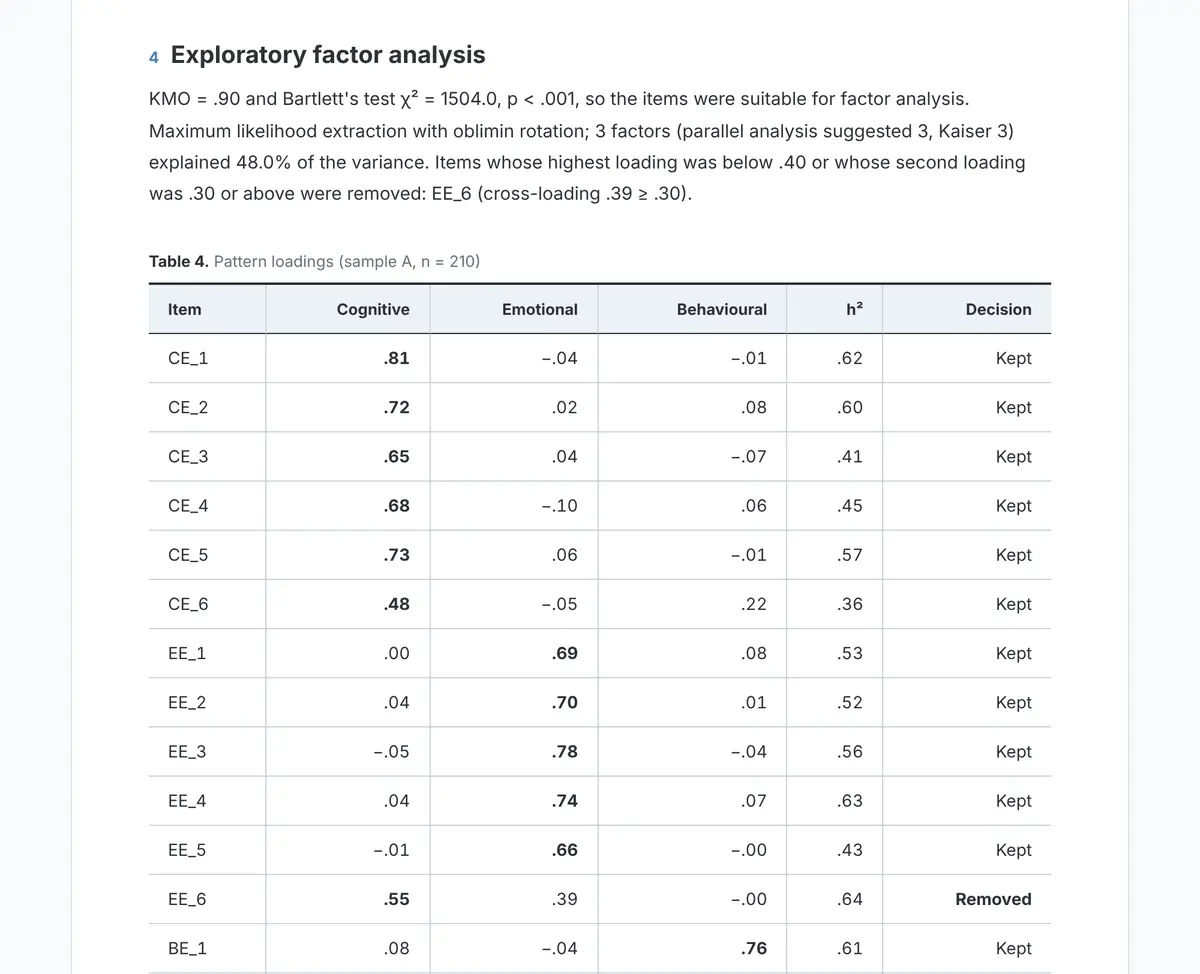
- Remove items loading below .40, or loading .30 or more on two factors
Confirmatory factor analysis (CFA)
This checks that the structure found in the EFA holds for other respondents too. That is why the sample is often split in half, so EFA and CFA use different people.
| What to check | Rule of thumb |
|---|---|
| Fit | CFI · TLI .90 or above, RMSEA · SRMR .08 or below |
| Convergent validity | CR .70 or above, AVE .50 or above |
| Discriminant validity | HTMT below .85 |
Reliability and criterion validity
A Cronbach's α of .70 or above for each sub-factor is usually taken as consistent measurement.
Measure an established scale (the criterion) alongside it, and if the correlation goes the expected way you have evidence of criterion validity. Some studies add measurement invariance, checking the scale means the same thing across groups such as gender.
How big a sample?
Running factor analysis twice takes a fair number of responses, so 300 or more is usually recommended. If you plan to split the sample, keep each half from falling below 150.
An example
Say you are building a digital fatigue scale. The sub-factors are cognitive fatigue · physical fatigue · avoidance, starting from 27 candidate items.
| Step | Result |
|---|---|
| Responses | 500 (sample A 250 · sample B 250) |
| Item analysis · EFA | 27 items → 20 items |
| CFA | CFI = .951, RMSEA = .058 |
| Reliability | α = .85–.88 |
How to report it
The sentence and numbers are an example.
Of the 27 candidate items for the digital fatigue scale, item analysis and exploratory factor analysis (sample A, n = 250) retained 20 items in three factors. Confirmatory factor analysis (sample B, n = 250) showed good model fit (CFI = .951, TLI = .943, RMSEA = .058, SRMR = .047), and Cronbach's α for the sub-factors ranged from .85 to .88.
In Skari
In Skari's research design, choose Scale development and validation and the scale-building screen opens.
Under "What does the scale measure?", enter the construct, who answers and the definition, then choose how it is developed (new scale · adapting a foreign scale · shortening a scale). Give each sub-factor a name and a code, and add a criterion scale for criterion validity.
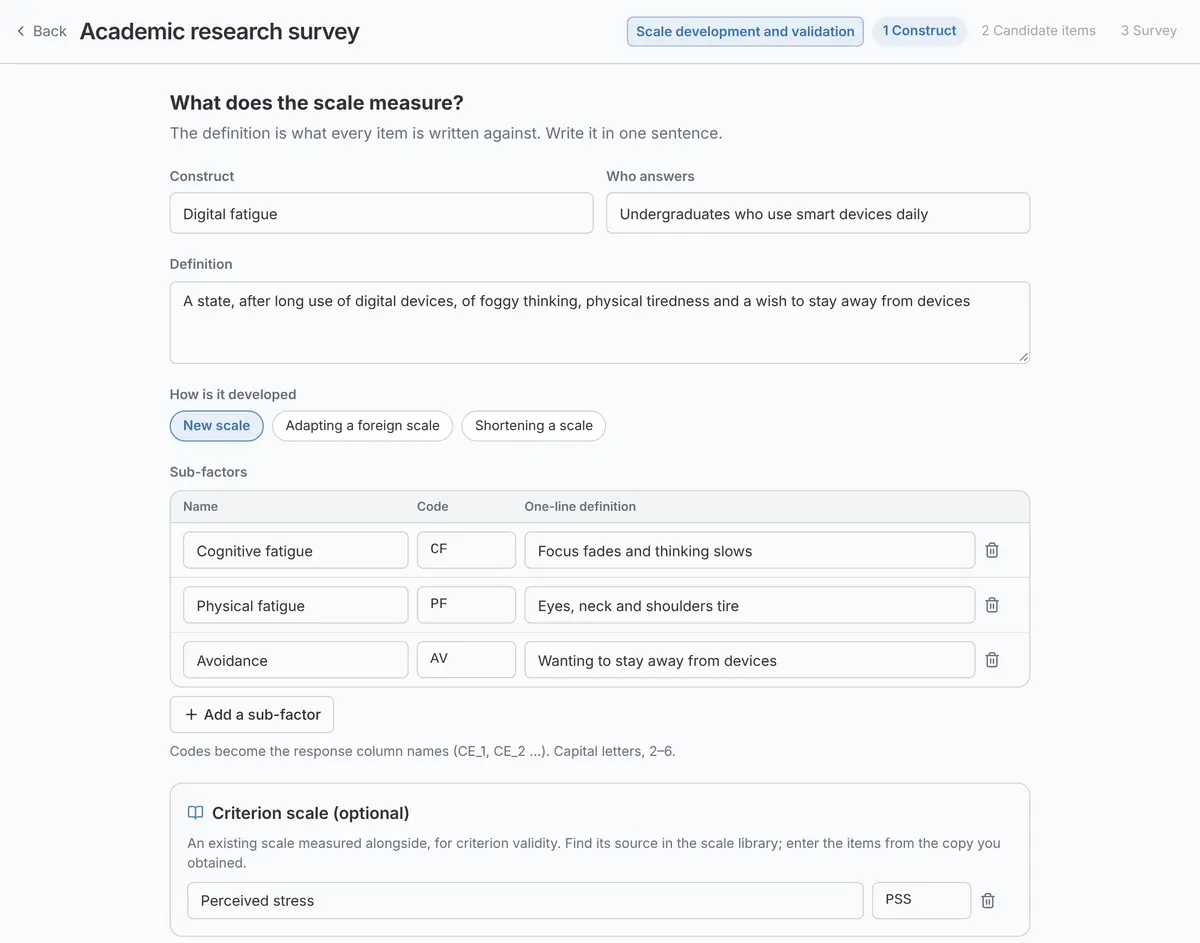
Start building your scale
Surveys → New Survey → Academic research survey → Scale development
In the next step you write candidate items for each sub-factor and mark reverse-worded ones. You can also get drafts with Draft more and read and edit them one by one.
Set the response scale (5 or 7 points) and respondent details, press Create the survey, and you get a survey with every item linked to its sub-factor.
Once responses are in, open Scale development and validation in the research report, pick the criterion variable and the group for measurement invariance, and decide whether to split the sample in half so exploration (A) and confirmation (B) use different respondents. The rules for removing items are shown right on the screen.
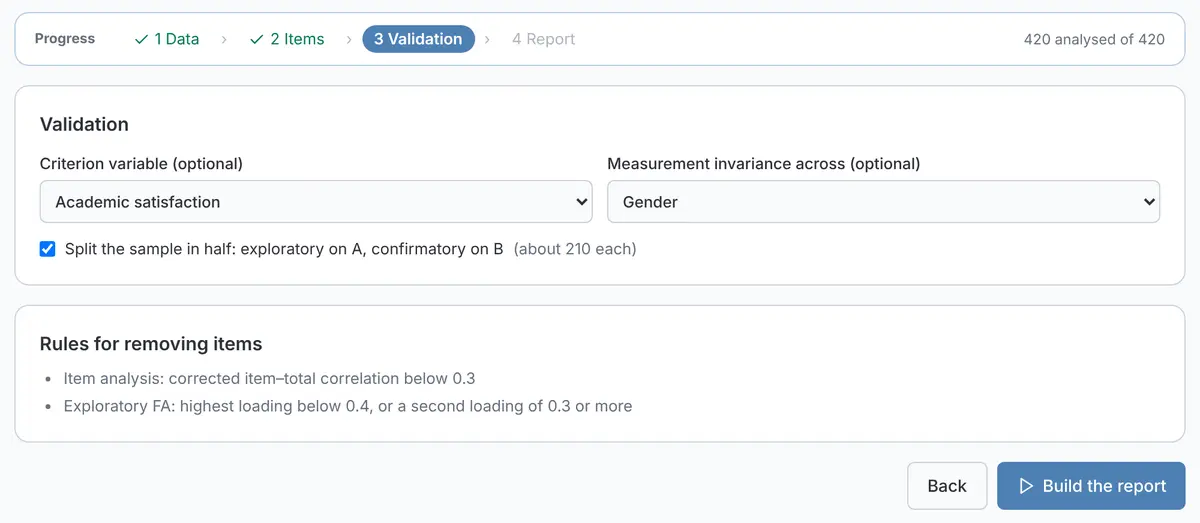
Press Build the report and everything — scale overview, item analysis, exploratory and confirmatory factor analysis, reliability, criterion validity, measurement invariance, the final scale and methods — is woven into one report.
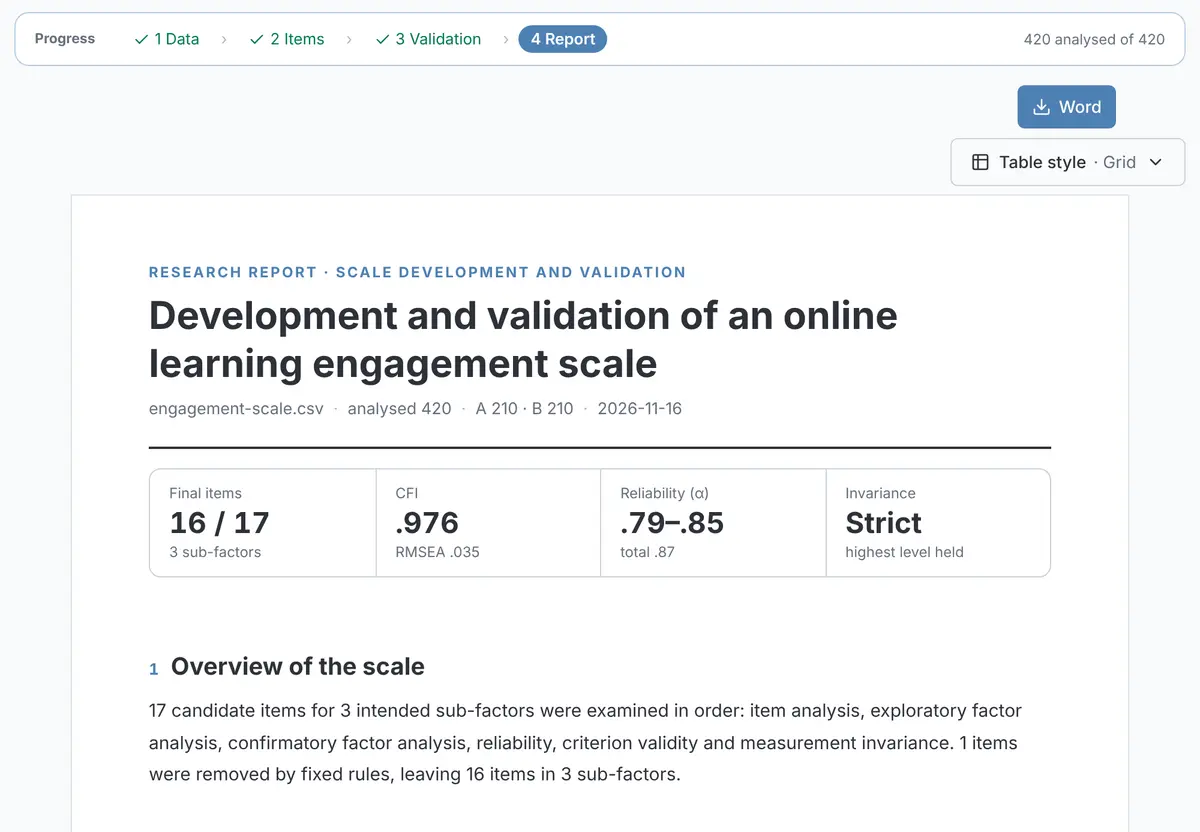
Each removed item is listed with the step and the reason it was dropped, and the report downloads as Word.
If you have not reached your response target yet, look first at an interim report covering item analysis, and run the factor analyses once you hit the target.
The heart of scale development is to "start from the definition and narrow down while keeping the evidence". Write plenty of candidate items, filter them against fixed rules, and you are left with a scale you can trust.
Want the theory behind it?The Academy's scale validation guide covers when and how to use reliability, EFA and CFA →