Reliability and validity, from Cronbach's alpha to CFA
You know alpha, but what shows validity? How to check both, and the cut-offs a thesis reports.
Responses are in and the data is clean, so it is time for the real analysis. But before you test a single hypothesis, one question always comes first.
"Did you check reliability and validity?"
You have heard of alpha, but what counts as evidence of validity, and what are CFI and RMSEA? It is confusing at first. Here is how to check reliability and validity, and the cut-offs a thesis usually reports.
Reliability vs validity
Think of a bathroom scale.
- Reliability — does it give about the same number every time? It measures the same thing consistently.
- Validity — is it really measuring your weight? It measures what it is meant to measure.
In a survey, whether the "depression" items are answered consistently with each other is reliability; whether those items really measure depression is validity.
Reliability — Cronbach's alpha
Reliability is usually checked with Cronbach's alpha (α). It runs from 0 to 1, and the higher it is, the more consistent the items.
- .70 or above is generally acceptable
- Exploratory studies sometimes accept .60 or above
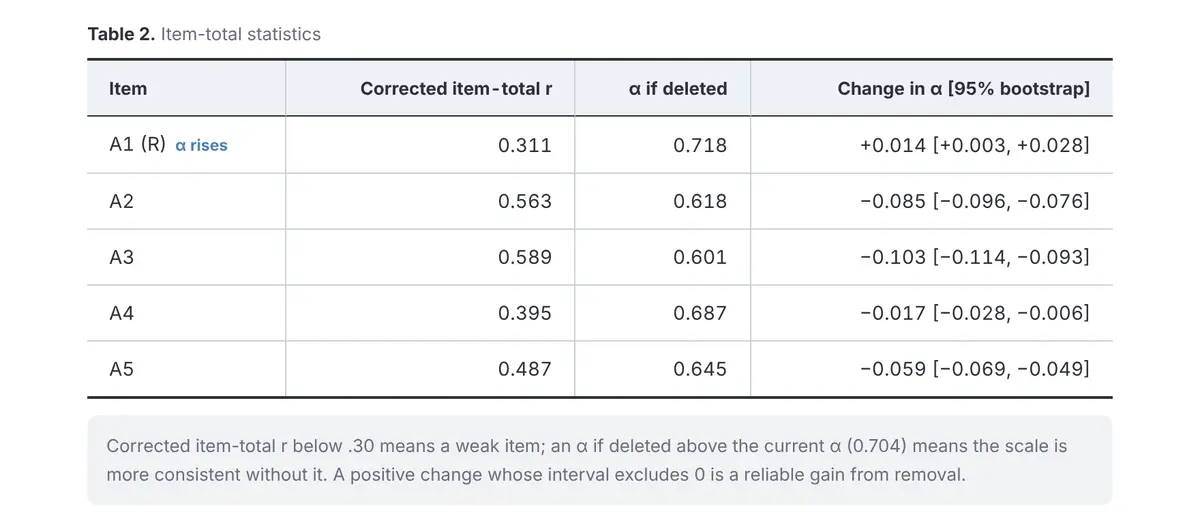
If alpha comes out low, look at "alpha if item deleted". If alpha jumps when one item is dropped, that item is moving differently from the rest.
And if alpha is oddly low or even negative, check first whether reverse-worded items were recoded.
Validity — confirmatory factor analysis
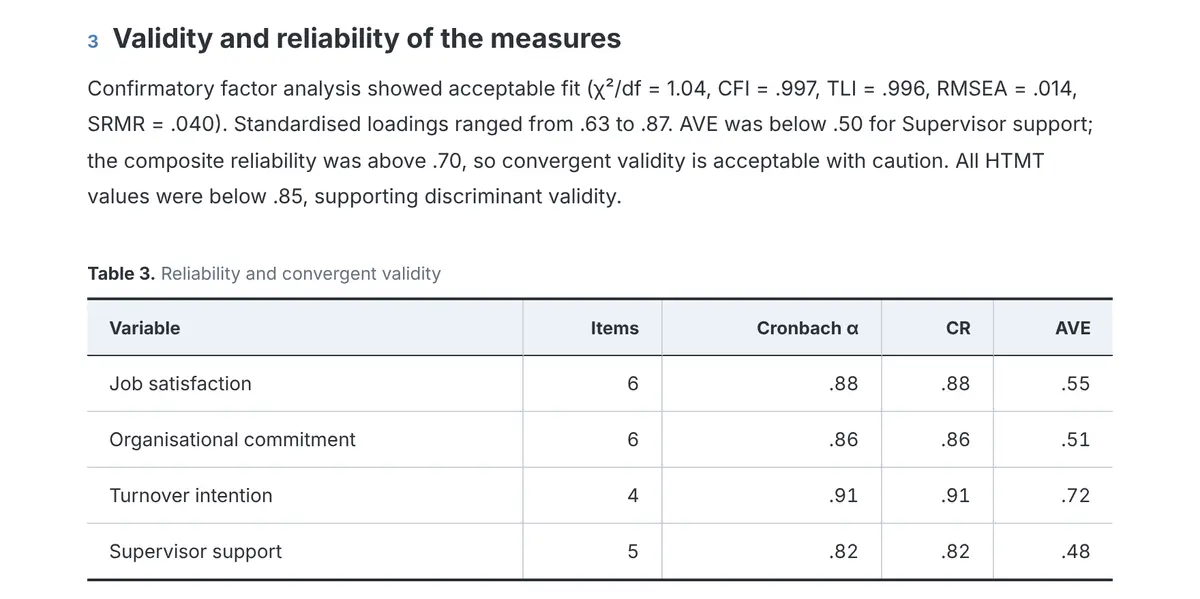
Validity is usually checked with confirmatory factor analysis (CFA): do the items load on the factors you assigned them to?
Start with the factor loadings — how well each item reflects its own factor. Around .50 or above is usually fine.
Next come the fit indices, which show how well the whole model matches the data.
| Index | Cut-off |
|---|---|
| χ²/df | 3 or below |
| CFI · TLI | .90 or above |
| RMSEA · SRMR | .08 or below |
These cut-offs vary a little by field and by the sources you cite, so check what the papers in your own field use.
Convergent and discriminant validity
More thorough papers, and papers that use structural equation modelling, report these two as well.
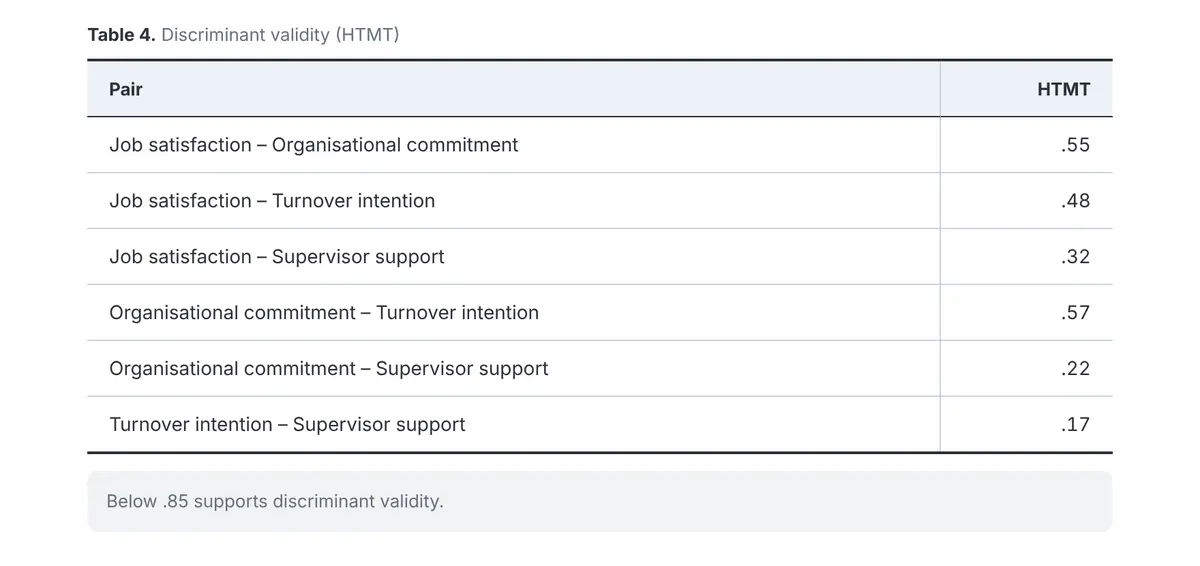
- Convergent validity — do items of the same factor hang together? Composite reliability (CR) .70 or above, average variance extracted (AVE) .50 or above
- Discriminant validity — are different factors distinct from each other? An HTMT below .85 is taken to mean they are
How to write it up
| Example sentence (the numbers are made up) |
|---|
| Scale reliability was assessed with Cronbach's α: smartphone overuse .891, depression .874 and sleep quality .762, all above the .70 threshold. The CFA showed good fit for the measurement model (χ²/df = 2.14, CFI = .934, TLI = .925, RMSEA = .061, SRMR = .052). |
In Skari
Computing alpha, running a factor analysis, working out CR and AVE separately, then checking each against a cut-off — it usually means jumping between several programs.
The Skari AI start screen lays out the tasks of a study in order, from finding prior research to writing up the report. Pick Survey results there, or just type what you want to do.
Skari analyses the survey responses you cleaned up last time, without uploading the file again.
It computes Cronbach's alpha for each scale and judges it against the .70 cut-off. It also shows how alpha changes when an item is dropped.
For the CFA, each fit index comes with its cut-off and a verdict, plus a sentence you can carry straight into your thesis.
Try it with your own survey
Pick Survey results in Skari AI
CR, AVE and HTMT appear on the same screen, with nothing to calculate by hand.
All the calculations run in R, and every result keeps the packages and code it used, so you can show them the moment an examiner asks.
Wrapping up
Reliability and validity are the evidence that your numbers can be trusted. When this step is solid, the hypothesis tests that follow carry weight. Next time we finally test a hypothesis with mediation analysis — bootstrapping and indirect effects included.
Want the theory behind it?The Academy's scale validation guide covers reliability, EFA and CFA, and which one fits which goal →