Mediation and indirect effects, made simple
It comes down to the indirect effect and its interval — from path names to bootstrapping and the write-up.
With reliability and validity checked, it is finally time to test your hypotheses. And the mediation hypothesis is where many people stop for a moment.
"How do I show there is a mediation effect?"
Some sources tell you to use the classic approach, others tell you to bootstrap, and it is easy to get lost. Here is how to test for mediation, step by step from the start.
What mediation is
Mediation means X affects Y by way of M.
For example: "heavier smartphone overuse leads to more depression, which in turn lowers sleep quality." Depression is the mediator that links overuse and sleep quality.
Know the path names first
| Path | Meaning |
|---|---|
| a | X → M (overuse → depression) |
| b | M → Y (depression → sleep quality) |
| c′ | The direct effect that does not pass through M |
| c | Total effect = c′ + a × b |
The size of the mediation is the indirect effect = a × b. In the end, what matters is whether this indirect effect is meaningful.
The classic way and today's way
The four-step method of Baron and Kenny and the Sobel test used to be the standard.
But the indirect effect (a × b) is often not normally distributed, so today bootstrapping is the more widely recommended way to test it.
What bootstrapping is
Bootstrapping resamples the responses in your own data at random and computes the indirect effect thousands of times.
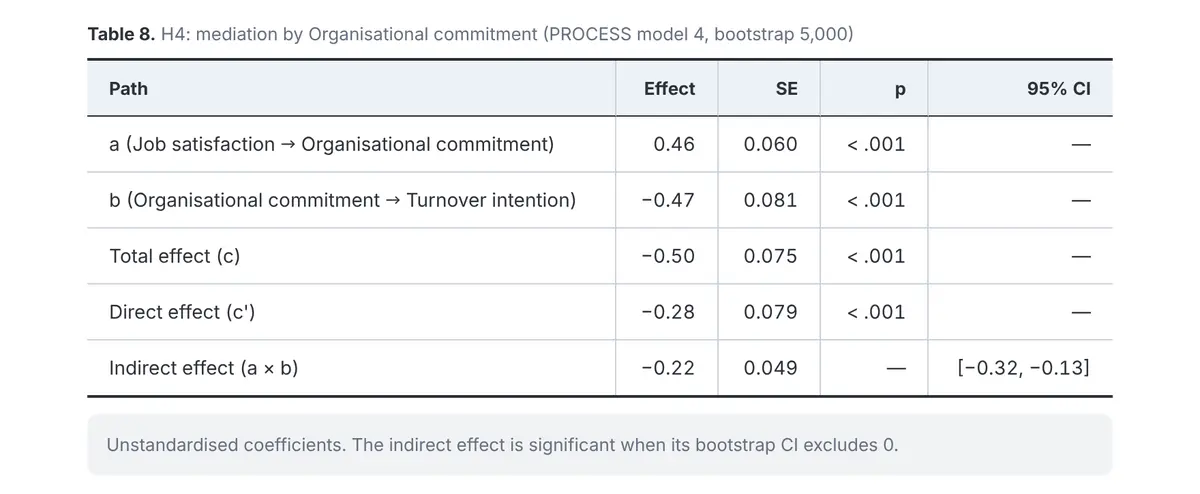
Those thousands of indirect effects give a 95% confidence interval, and if 0 is not inside it, you conclude there is a mediation effect. Papers usually use about 5,000 resamples.
Full and partial mediation
- An indirect effect, and the direct effect (c′) is still significant → partial mediation
- An indirect effect, and the direct effect disappears → full mediation
These days, though, reporting the size of the indirect effect and its confidence interval precisely is often seen as more important than this label.
How to write it up
| Example sentence (the numbers are made up) |
|---|
| In the effect of smartphone overuse on sleep quality, the indirect effect through depression was −.16 (95% CI [−.23, −.10]); the interval did not include 0, so the effect was significant. Hypothesis 4 was therefore supported. |
In Skari
Installing the PROCESS macro, picking a model number and copying numbers out of the output tables — it is easy to slip up.
The Skari AI start screen lays out the tasks of a study in order, from finding prior research to writing up the report. Pick Survey results there, or just type what you want to do.
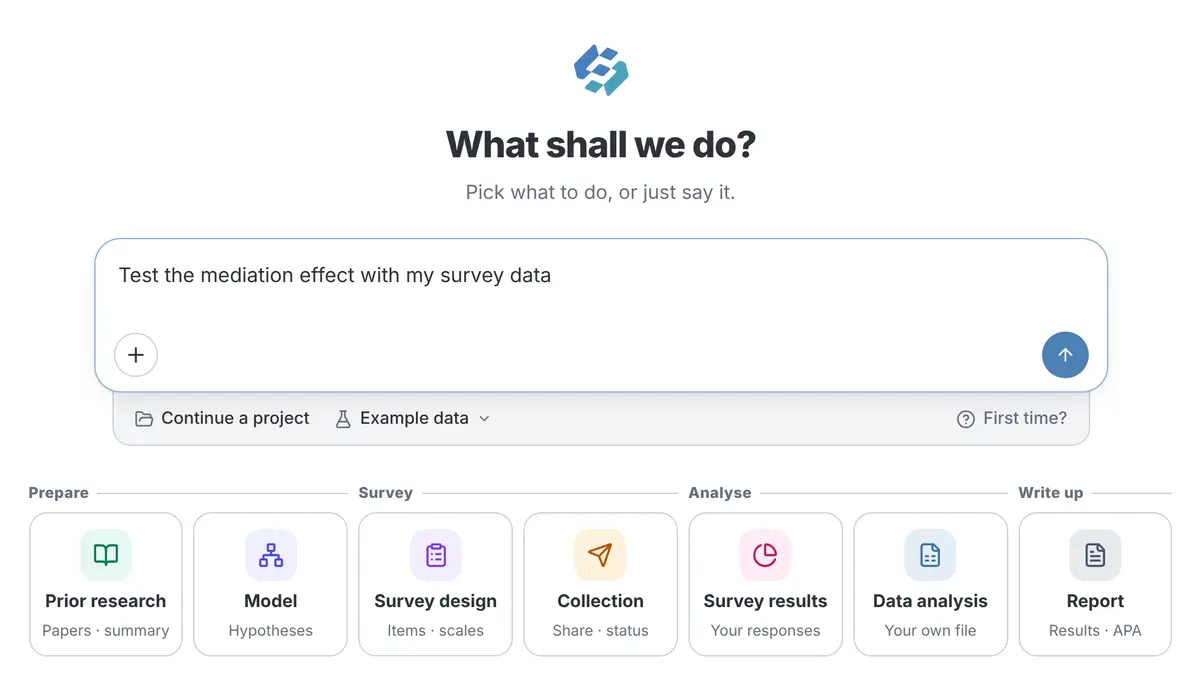
Skari tests the mediation hypothesis from your research model directly on your survey responses.
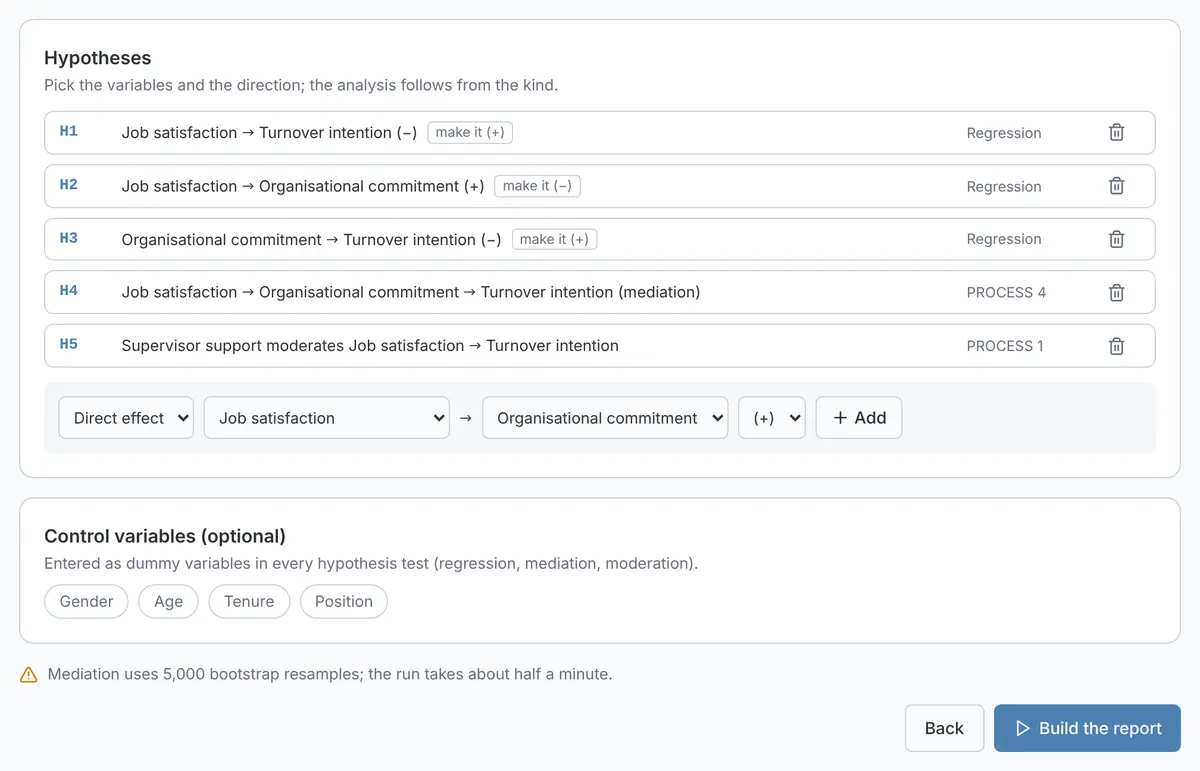
The analysis matching PROCESS model 4 is computed in R, and the indirect effect gets a confidence interval from 5,000 bootstrap resamples and a verdict straight away.
Try it with your own survey
Pick Survey results in Skari AI
Whether each hypothesis is supported lands in one table, together with result sentences you can carry into your thesis.
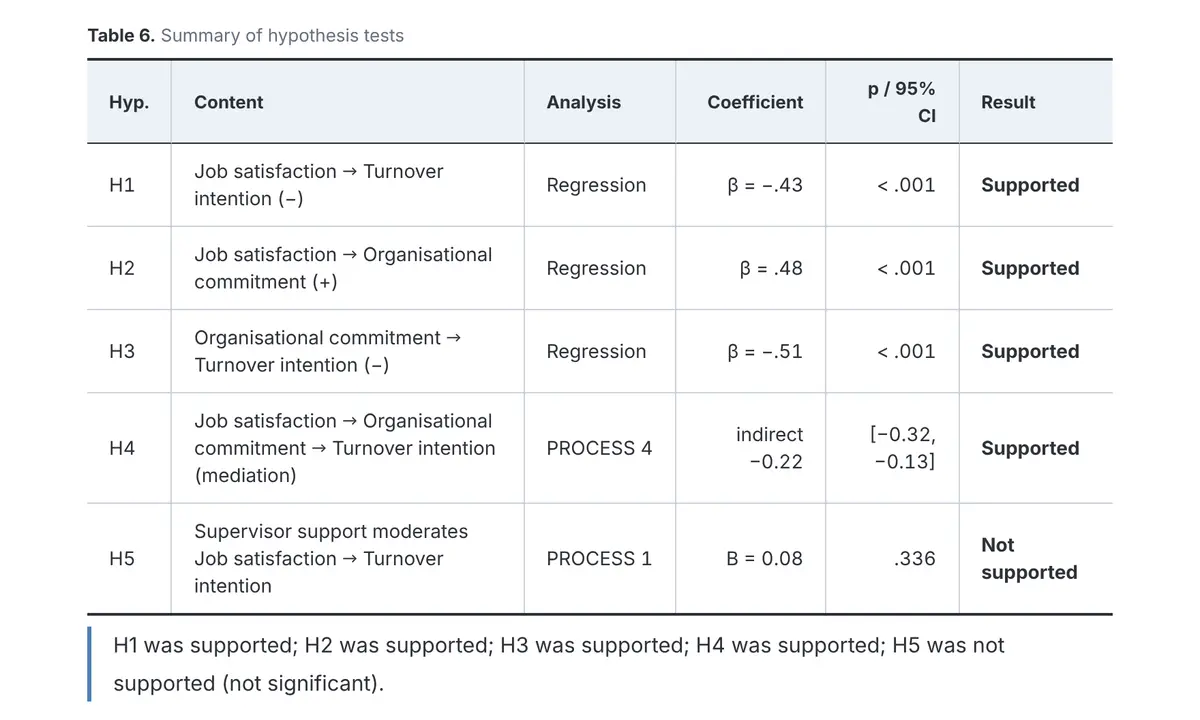
Parallel mediation, serial mediation, moderation and moderated mediation are tested the same way.
Wrapping up
The heart of mediation is the indirect effect and its confidence interval. Remember to check whether it includes 0, and results tables become much easier to read. Next time we test the whole model at once with structural equation modelling (SEM).
Want the theory behind it?The Academy's Mediation chapter covers paths a, b and c′, the indirect effect and bootstrapping in depth →