Map the field, find the gap
Read a field’s trends, its four kinds of literature network, and the strands and gaps they reveal.
The deeper you go into prior research, the more papers pile up — until one question stops you.
"So where is this field heading?"
Reading one paper at a time doesn't show the field's overall direction or how the studies cluster. Here is a step-by-step look at research trend analysis and literature network analysis.
Two ways to see the forest first
- Research trends — paper counts, journals, countries and fields: "how much, and where"
- Networks — keywords, references, authors and citations: "what goes with what"
With both in hand, your literature review chapter can argue far more convincingly why your study is needed.
Reading research trends
| Item | What it tells you |
|---|---|
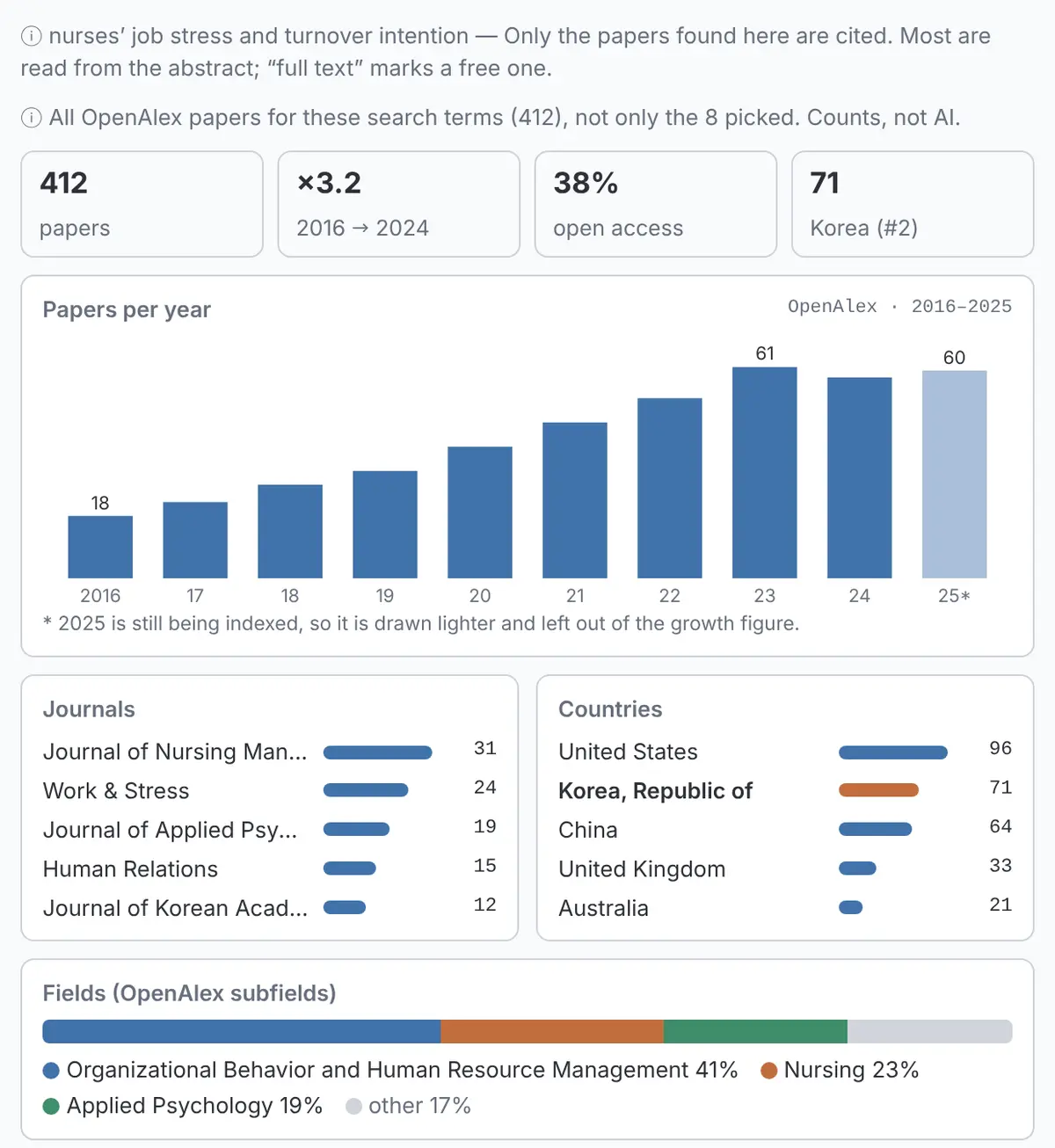
| Papers per year | Whether interest is growing |
| Top journals | Where the topic is published most |
| Countries | Where it is studied most |
| Fields | Which disciplines cover it, e.g. psychology or public health |
| Open access | The share of papers free to read |
One tip: the current year is not fully indexed yet, so its count usually looks low. Judge growth up to last year.
Four kinds of network
| Network | What it links | What you see |
|---|---|---|
| Keyword co-occurrence | Keywords on the same paper | Which topics are studied together |
| Bibliographic coupling | Two papers citing the same references | Papers with shared theoretical roots |
| Coauthorship | Authors who wrote together | The field's research groups |
| Citation | Papers citing each other | Which papers sit at the centre |
Reading network results
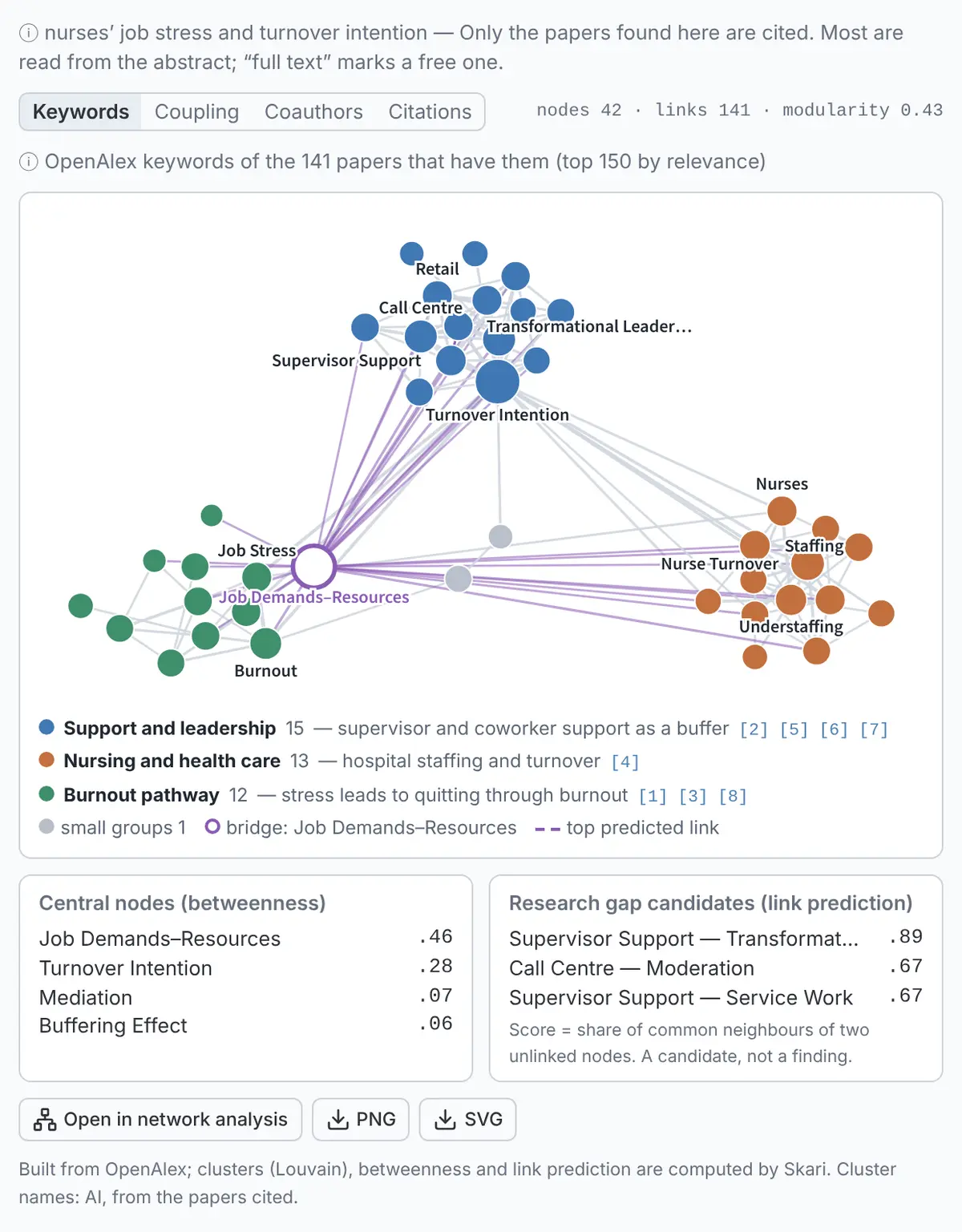
- Clusters (strands) — tightly linked groups of nodes; each is one research strand
- Modularity — how clearly the strands separate (higher is clearer)
- Betweenness centrality — "bridge" nodes that connect strands
- Link prediction — unlinked pairs that share many neighbours
Link prediction points to combinations no paper has covered yet, so it suggests candidate research gaps. They are only candidates — read the papers to judge whether a gap really matters.
An example — climate anxiety
Search "climate anxiety" and you'll find papers have grown sharply in recent years. The keyword network might split into strands like these.
| Strand | Typical keywords |
|---|---|
| Mental health and emotion | depression · worry · well-being |
| Pro-environmental action | climate action · collective efficacy · hope |
| Scale development | scale validation · measurement invariance |
| Youth and education | young people · education · social media |
If coping bridges several strands, a study explaining how climate anxiety turns into action through coping suggests itself. And a pair no paper has covered yet, such as "social media — collective efficacy", can seed a new research question.
How to write it up
You might write something like this (sentences and numbers are illustrative):
"Papers on climate anxiety grew from 12 in 2016 to 840 in 2025. The keyword network split into four strands — mental health and emotion, pro-environmental action, scale development, and youth and education — with coping linking them."
In Skari
Search a topic with Prior research in Skari AI and you get Trends · Map · Report tabs next to the paper list.
The Trends tab shows the whole field for the same search terms: papers per year, top journals, countries, fields and open-access share. It is drawn from OpenAlex counts with no AI, so there are no invented numbers.
The Map tab switches between keyword, coupling, coauthor and citation networks. Skari computes the clusters (Louvain), betweenness and link prediction itself; the AI only names the keyword clusters. Every name carries the numbers of the papers behind it, one click away.
Map your own topic
Start with Prior research in Skari AI
Download the figure as PNG or SVG, or press Open in network analysis to explore the same links in the network analysis screen.
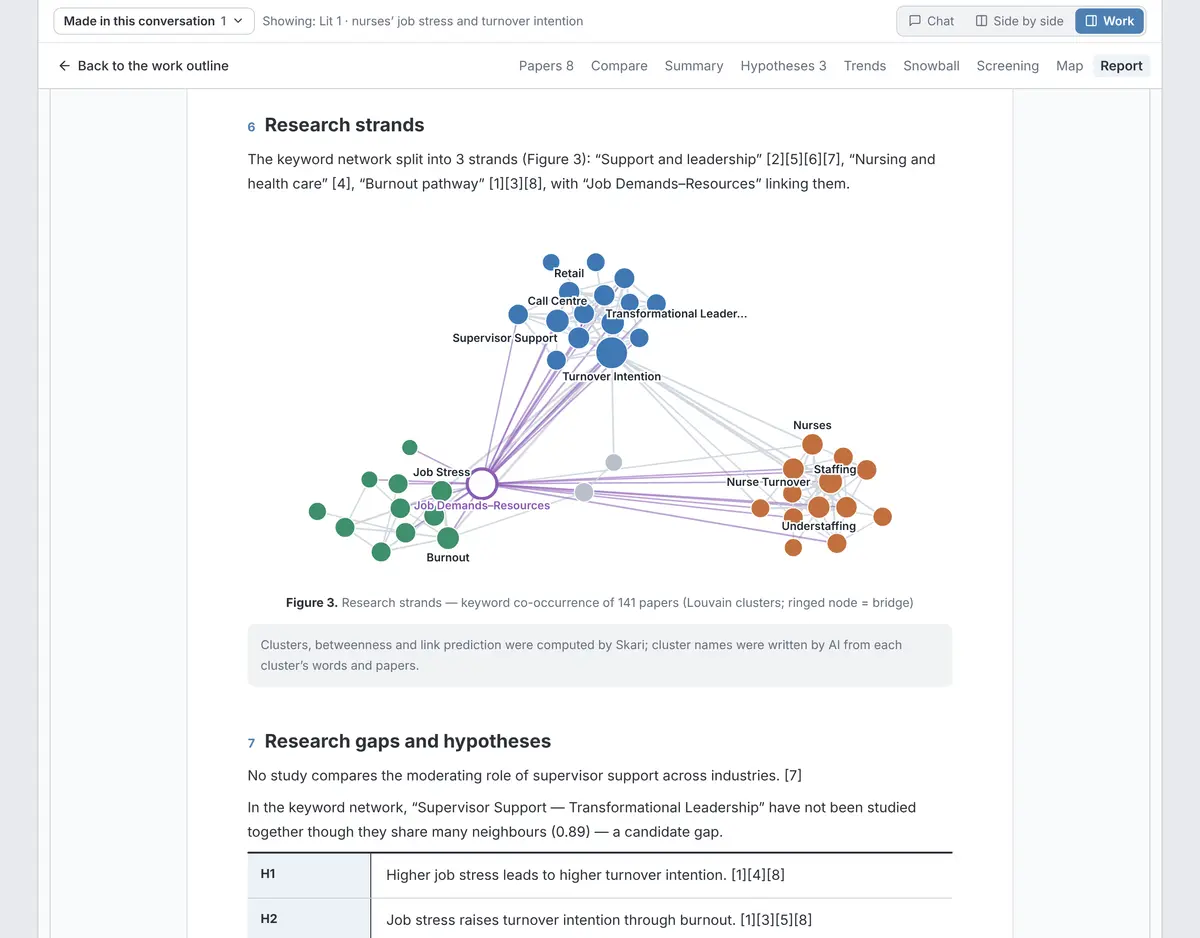
Finally, the Report tab weaves it all into a draft literature review chapter.
- Study selection · research trends · key prior studies
- Relations between variables · measures and methods
- Research strands · gaps and this study's hypotheses · references
Numbers, figures and tables are computed, and only sentences with cited sources go in. Download it as Word or save it to a project, then move on with Build the theory model.
Reading papers one by one still matters, but seeing the forest first tells you which trees to read. Use trends for the direction and networks for the strands and gaps, then find where your study fits.
Want the network measures explained?The Academy's social network analysis page covers centrality and clusters in depth →