Defense stats questions: show how you did it
The statistics questions examiners ask most, what to write in your Methods chapter, and how to show the result reproduces.
Once the thesis is written, the defense is the last gate. And statistics questions, when they come out of nowhere, are the easiest to be thrown by.
"How exactly did you get this result?"
Here are the statistics questions examiners ask most, and how to prepare for them.
Questions you'll likely get
- Why did you choose this method?
- How did you handle missing data?
- How many careless responses did you drop, and why?
- How many bootstrap resamples did you use?
- Which software, and which version?
- Would you get the same result if you ran it again?
Most are about the process. Examiners care less about the numbers than how you computed them.
Put the answers in your Methods chapter
Write these answers into your Methods chapter in advance and the defense gets much calmer.
- Software and version
- Significance level (e.g. α = .05)
- How missing data were handled
- Criteria and count for excluding careless responses
- Number of bootstrap resamples and type of confidence interval
Cite your software too
If you used R, cite R and the packages you used. For example (the year is illustrative):
- R Core Team (2026). R: A language and environment for statistical computing. R Foundation for Statistical Computing.
- Rosseel, Y. (2012). lavaan: An R package for structural equation modeling. Journal of Statistical Software, 48(2), 1–36.
For R, use the year the version you ran was released.
Reproducibility, the surest answer
Reproducibility means anyone analysing the same data the same way gets the same result. Keep the data and code you used, and you can answer "would it come out the same?" with certainty.
In Skari
Recording every analysis setting is harder than it sounds.
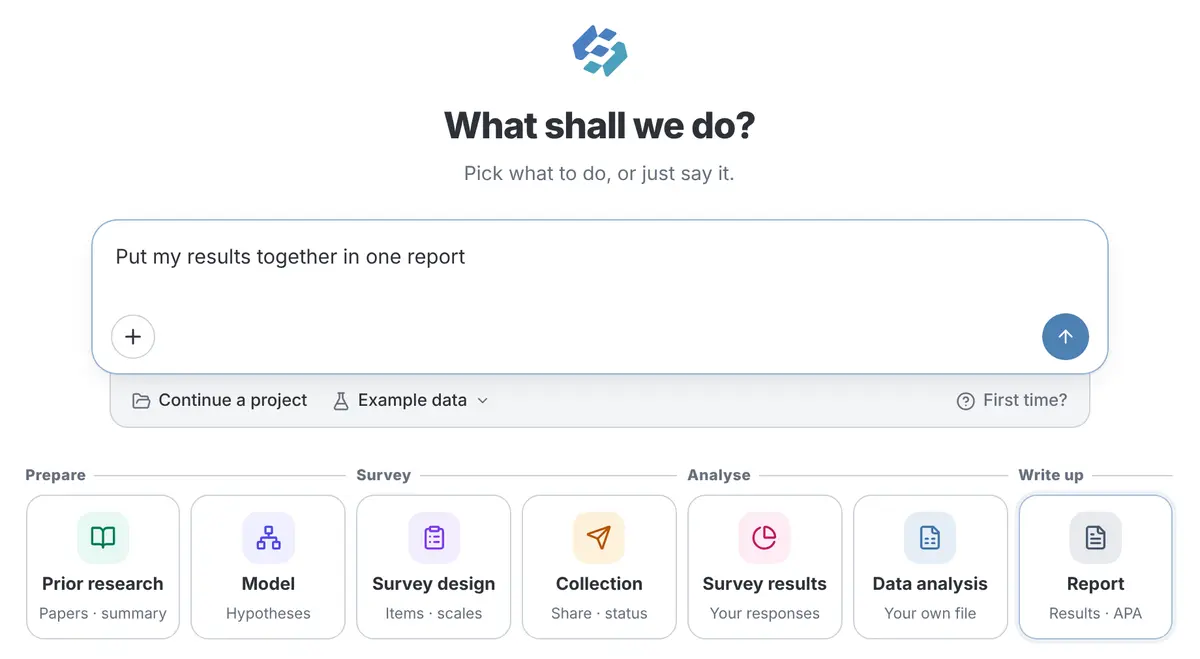
The Skari AI start screen lays out the work in research order, from prior research to the report. Pick Report, or just type what you want to do.
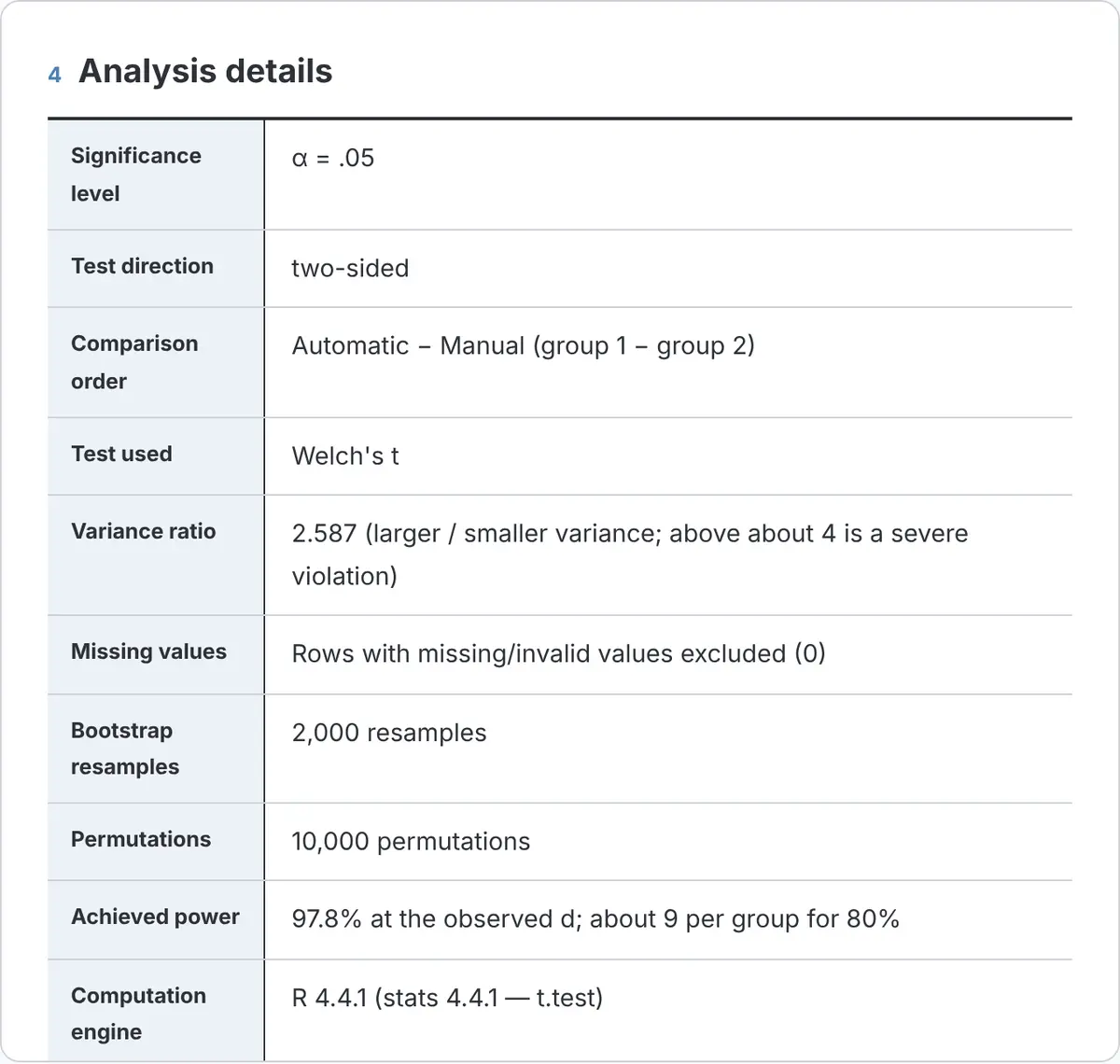
Every Skari report ends with Analysis details: significance level, the test used, missing-data handling, and the R and package versions used for the computation — ready for your Methods chapter and for the defense. A mediation report also lists how the indirect effect was tested (bootstrap resamples) and the run date.
Turn your results into a report
Pick Report in Skari AI
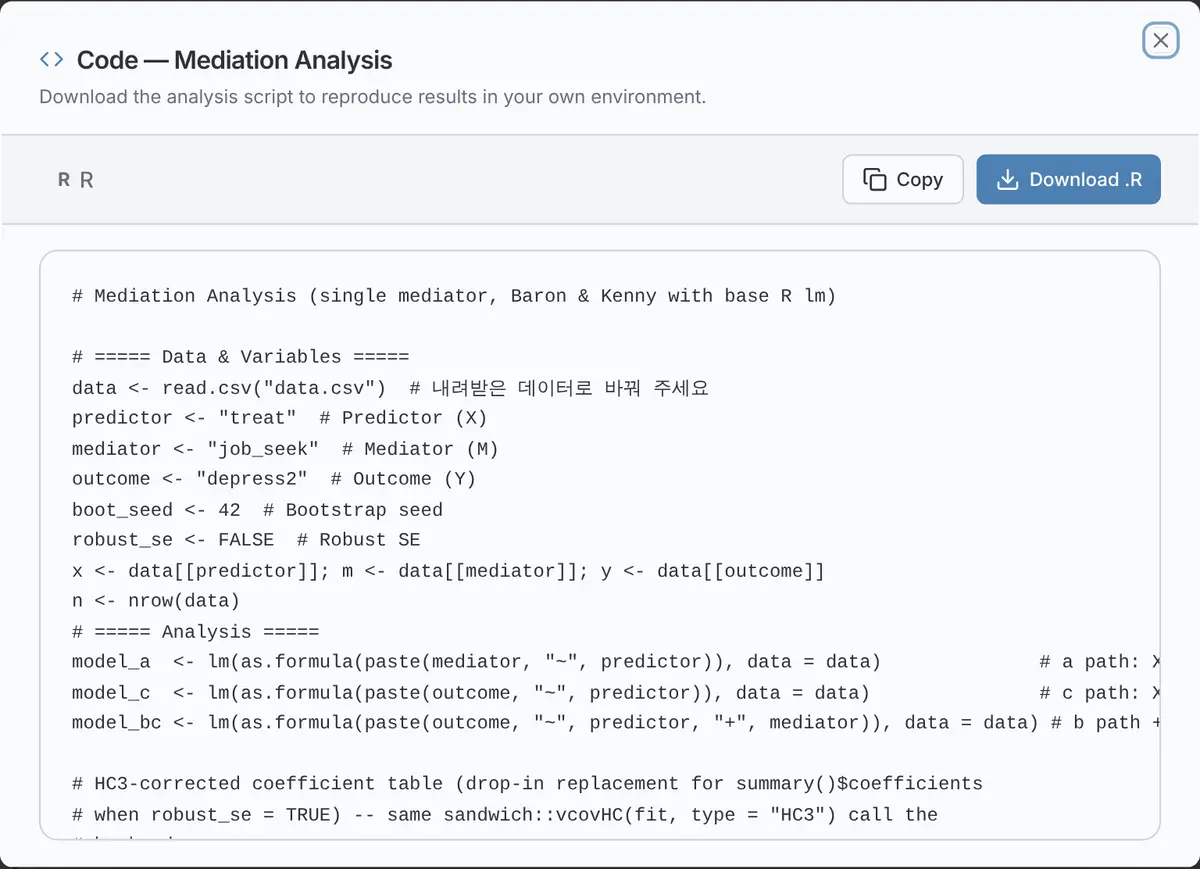
The computation runs in R, and each analysis offers its R code to download, so you can rerun it in R on your own computer and get the same result.
Skari also publishes the records of checking its results against R and Python.
In the end, every statistics question at a defense means "show me how you did it". Record your process and keep code that reproduces it, and you can answer any question calmly.
Ready for the missing-data question?The Academy's missing data imputation page covers methods and how to report them →