Moderation, from simple slopes onward
When an effect depends on a third variable: the interaction term, simple slopes, and moderated mediation (PROCESS 1 · 7 · 14).
"Exercise reduces stress." You have heard it many times.
But does it really work the same way for everyone? Could the effect differ between people who have someone cheering them on and people who don't?
"What if the effect differs by person and situation?"
The analysis that answers this is moderation analysis. Here is moderation, simple slopes and moderated mediation, step by step.
What moderation is
Moderation means the size or direction of X's effect on Y depends on a third variable, W.
W is called the moderator. In today's example we ask whether social support (W) changes the effect of exercise time (X) on stress (Y).
How it differs from mediation
- Mediation — "how, and why?" X affects Y by way of M
- Moderation — "when, and for whom?" the size of X → Y changes with W
A mediator links X and Y; a moderator changes the strength of the X → Y relationship.
How to test it
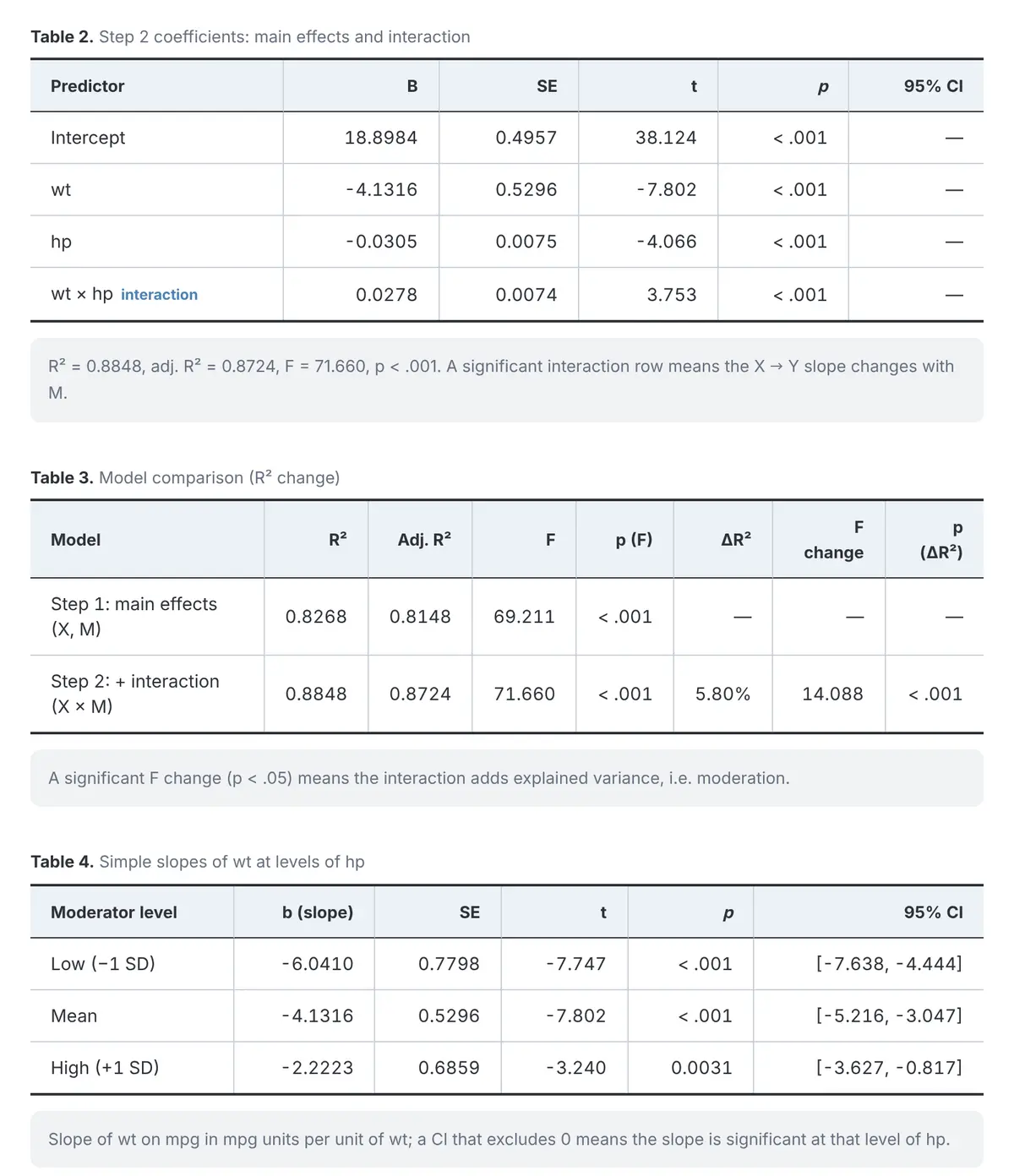
Add the interaction term (X × W) — X multiplied by W — to the regression and see whether it is significant.
| Step | What you do |
|---|---|
| Step 1 | Enter X and W only (main effects) |
| Step 2 | Add the X × W interaction term |
| Verdict | A significant interaction and an R² change (ΔR²) mean moderation |
Mean-centring X and W before multiplying makes the main effects easier to read at average levels. In Hayes's PROCESS this is model 1.
See the shape with simple slopes
A significant interaction alone does not tell you how the effect changes.
So you compute the X → Y slope when W is low (−1 SD), average and high (+1 SD) — these are the simple slopes.
Draw the three lines in one plot and the moderation shows at a glance as lines fanning out. Parallel lines mean no moderation.
What moderated mediation is
Sometimes the size of a mediation effect (X → M → Y) depends on a moderator. This is moderated mediation.
- PROCESS model 7 — W moderates the first path (X → M)
- PROCESS model 14 — W moderates the second path (M → Y)
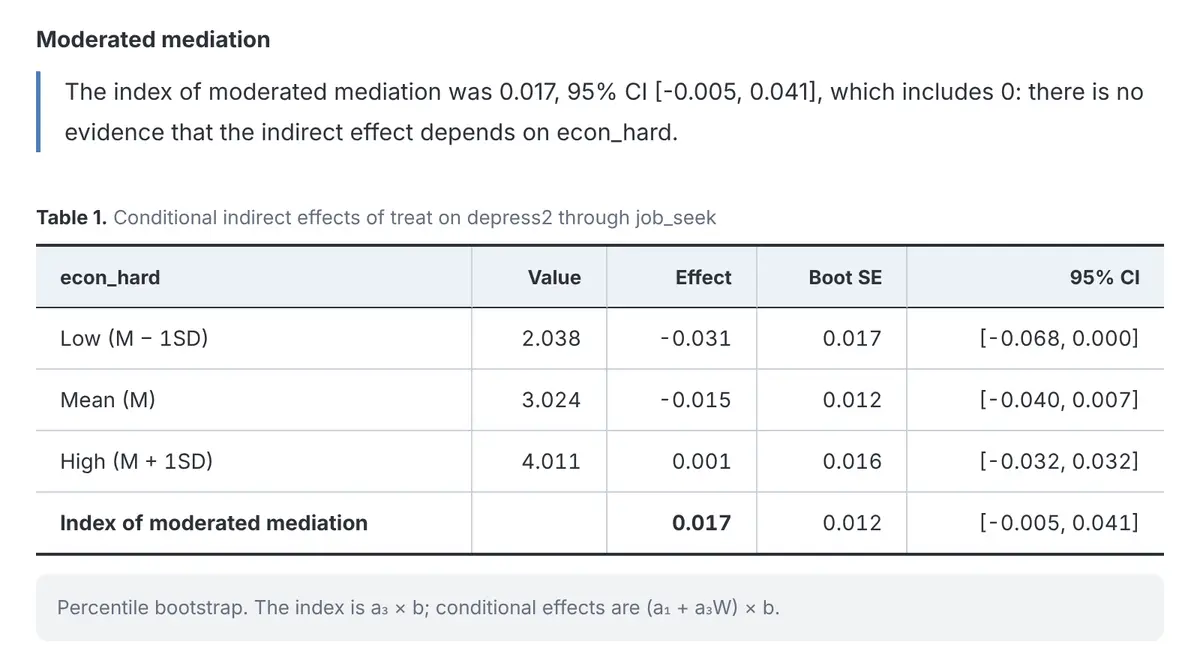
You compute the conditional indirect effect at each level of W, and if the bootstrap confidence interval of the index of moderated mediation excludes 0, you conclude there is moderated mediation.
What to prepare
- A theoretical reason to expect moderation
- A generous sample — interactions need more data than main effects, so 100 or more is the usual advice
- A wide enough range of the moderator — if everyone has similar values, moderation is hard to find
An example
We asked 284 office workers about weekly exercise time, social support and stress.
| Part | Result |
|---|---|
| Interaction | B = −0.14, p < .001, ΔR² = .032 |
| Low social support | slope −0.07 (not significant) |
| Average social support | slope −0.18 |
| High social support | slope −0.29 |
The more social support people had, the more their stress fell as exercise time went up. For people with little support, exercise time and stress were not clearly related.
How to write it up
The interaction between exercise time and social support had a significant effect on stress (B = −0.14, p < .001, ΔR² = .032). Simple slopes analysis showed that exercise time significantly lowered stress when social support was high (+1 SD; b = −0.29, p < .001) but not when it was low (−1 SD; b = −0.07, p = .243).
Example sentence · the numbers are illustrative
Putting a simple slopes table and plot next to the moderation table makes the result much easier to get across.
In Skari
In Skari's research design, pick Mediation · moderation and the model screen opens.
In Choose or draw the model structure, pick Moderation and add your variables: it becomes PROCESS model 1, and each hypothesis comes with the analysis that tests it. Moderated mediation (first stage) is PROCESS model 7 and (second stage) is model 14.
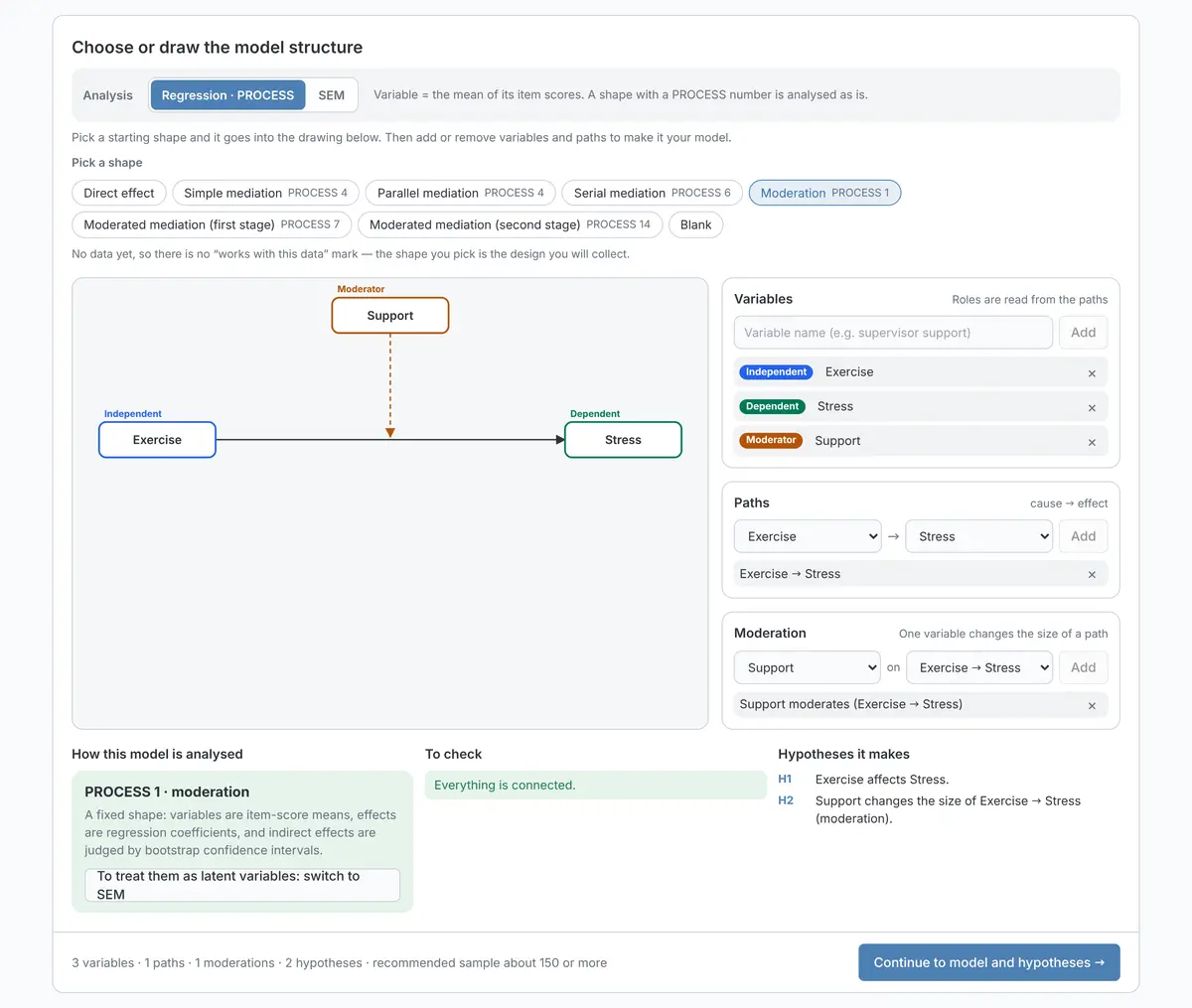
Once responses are in, the hypothesis tests in the research report include a moderation table (mean-centred terms, interaction term, R² change) and a simple slopes table at each level of the moderator.
To try it straight away on a data file you already have, open Moderation Analysis and pick the independent variable, moderator and dependent variable. You can add covariates too.
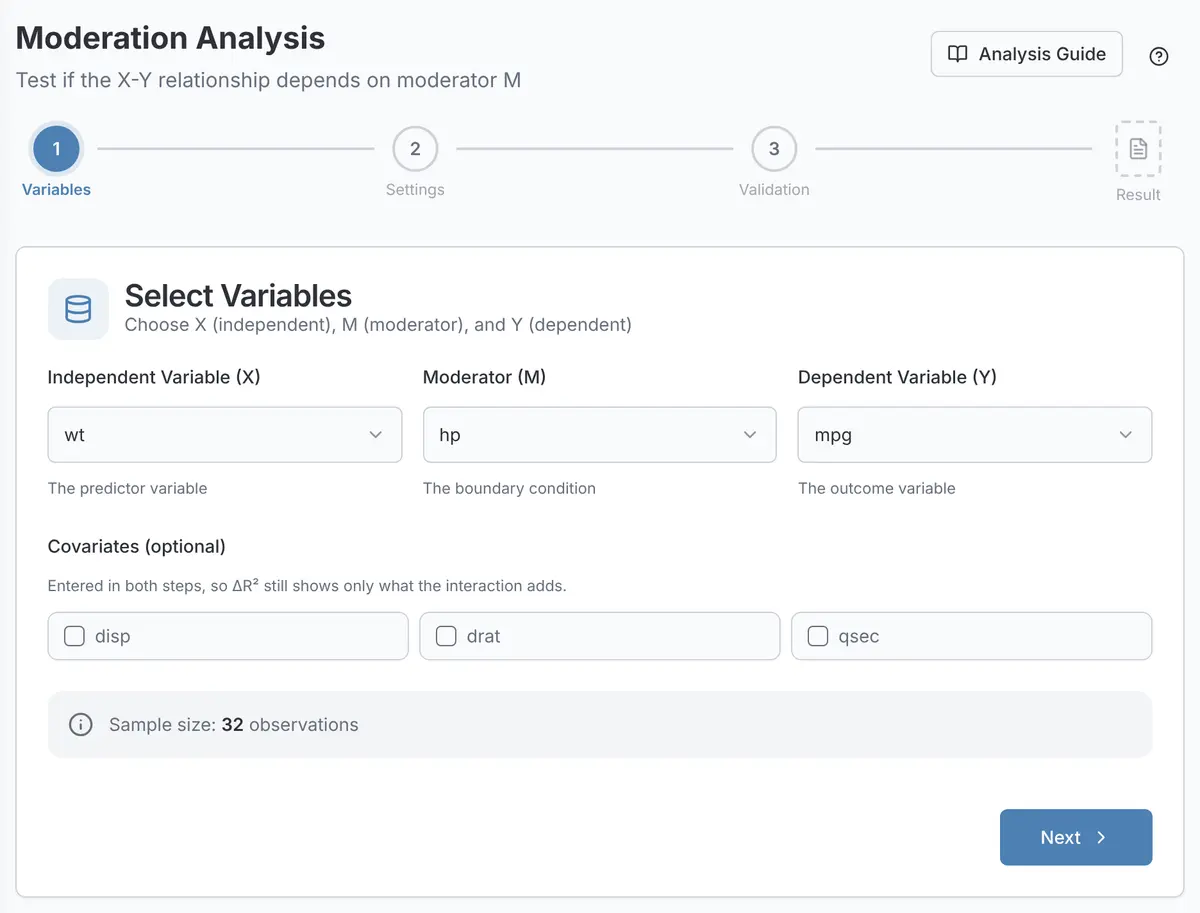
Check moderation in your own data
Opens straight from Moderation Analysis
For moderated mediation, open Mediation Analysis, choose a variable under Moderator (optional) — moderated mediation, and set whether it moderates the first path (model 7) or the second (model 14).
For example, you can check whether social support moderates the first path of exercise time → positive affect → stress. Skari shows the conditional indirect effect at each moderator level and the index of moderated mediation, with bootstrap confidence intervals.
Wrapping up
Moderation shows "for whom, and when, the effect appears". Confirm it with the interaction term, draw its shape with simple slopes, and the result becomes much clearer.
Want the theory behind it?The Academy's Moderation chapter covers the interaction term and simple slopes in depth →